Know before the bot does.
pro·noi·a — the sense that something is quietly working in your favorA marketplace's dashboard flags what that marketplace has already raised, against its own rules. Pronoia reads your listings export and flags the risk before the platform asks, fix attached. Nothing is written to your listings. No account access, ever.
term is priced against before it ships*
- You export one file. The listings report your marketplace already gives you.
- We read it against our rule engine. No login, no API, nothing written back.
- You get a per-SKU list. Rule, reason, and the fix spelled out — with the exact wording where wording is the fix. Usually same day.
Rewrite as a structure/function claim and add the disclaimer 21 CFR 101.93(c) requires.
Do not add it. No EU disclaimer replaces it: Reg (EU) 1169/2011 Art 7(3) bars the claim outright.
-
Aug 2026
Rule shippedR-EPREL-REG
EPREL energy registration became required in eight EU stores
And deleted from the UK in the same release.
-
Aug 2026
Rule shippedR-FBO-NAME
Food Business Operator Name landed on 133 food product types
Eight stores, and Germany is removing it in the same release.
-
Jul 22, 2026
Rule shippedR-FCC-CERT-ID
The FCC put the duty to verify FCC IDs on the marketplace
Published September 11, 2026. The duty starts on March 1, 2027 where the marketplace holds or owns the device, June 1, 2027 where it relies on seller certification. It reaches listings published or updated from October 13, 2026, by high-volume third-party sellers; used devices are excluded (47 CFR 2.803(c)(3)). Exposure, not yet enforcement.
You find out on the platform's schedule, not yours.
In the six months to Dec 31, 2025 Amazon logged 113.1 million own-initiative enforcement measures in the EU under “unsafe and prohibited products”, against 45,652 notices in that category from anyone at all. It starts on Amazon's side, on Amazon's schedule.
Amazon's own forum says compliance-document review runs “up to 15 business days (weekends are not counted).” A ceiling, not an average, and which end you get is not yours to decide. Appealing starts no faster clock.
The live set runs today; four more are specified and not yet built. Appeal shops sell the cure, RP services cover one regulation each. We read what trips the bot, first.
The system that suppresses you is the system that ranks you. On Amazon these are not two problems: the SP-API documentation names missing compliance attributes as a worked example of SEARCH_SUPPRESSED, so the same gap that risks the takedown is the one holding the listing out of search.
Read your catalog's barcode before the bot scans it.
 Guided tour ↗
Three steps. Zero credentials.
Nothing is written to your listings. Pronoia reads the export you already have and hands you the fixes. You paste them. Nothing reaches the marketplace unless you send it.
Export your listings file
One flat file from your seller portal. On Amazon it already carries the compliance attributes the platform reads: GPSR fields, battery data, dangerous-goods flags, category nodes. Coverage per platform is whatever that platform actually lets you download, and the FAQ says where each one stops.
Walmart: Item Report, or the Item Spec you upload · eBay: Seller Hub · Google: the feed file you already author
(Amazon: included with Professional selling accounts, nothing to switch on. Amazon generates the file on its own clock and its help page says that can take up to three days, so request it and come back. Others: one support ticket if it is not visible.)
Pronoia runs the rule set
Every SKU is scanned for missing attributes, restricted keywords, high-risk nodes and format defects. Amazon runs "more than ten thousand safety and compliance keyword-based algorithms" on its side of the wall. We run the same shape of check on yours, first.
Fix the red rows this week
Every flag ships with remediation copy you can paste straight back into the listing, ordered by suppression risk: red first, then amber for review.
Built from real suppressions, not guesswork.
Each rule maps to a documented 2024–26 enforcement pattern. High-confidence rules read attributes and text directly; medium-confidence rules flag exposure for review; a third kind renders no verdict at all and is excluded from the red/amber/green counts. One ruleset, per-platform adapters.
| Rule | Checks | Enforcement pattern | Confidence | Status |
|---|---|---|---|---|
| R-META-UNEVALUABLE | Columns absent from the export, distinct from empty | Rules that cannot run return NOT EVALUATED, never green | High | Live |
| R-GPSR-RP | EU SKUs missing Responsible Person attribute | GPSR bulk removals since Dec 2024 | High | Live |
| R-GPSR-MFR | EU SKUs missing manufacturer reference | GPSR listing blocks | High | Live |
| R-GPSR-ATTEST | Missing safety attestation / compliance media | Silent GPSR approval blocks | High | Live |
| R-GPSR-FORMAT | RP data present but format-defective | Rejections with no stated reason | Med | Live |
| R-KW-PESTICIDE | "Antibacterial", "kills germs", "repels" + 20 terms | Textiles reclassified as pesticides | High | Live |
| R-KW-DISEASE | Disease and organ claims in listing copy | 10-year listings pulled for one phrase | High | Live |
| R-KW-LOCALE | Rows in languages our keyword dictionaries do not cover | English patterns cannot clear non-English copy | High | Live |
| R-KW-SUPPLEMENT | Supplement claims vs label facts mismatch | 2026 cGMP suppression wave | Med | v1 spec |
| R-CPC-NODE | Children's nodes with no compliance media on file, or a document whose type no export can state | CPC demands, deactivation first | High | Live |
| R-CPC-MEDIA | Certificate on file but failed validation or expired | A rejected document counts as none | High | Live |
| R-CPC-AGE-WARN | Row grades itself for children under 6 and carries no small-parts age warning. Reads the seller's own age grading, so no category guess. Silent on teen and adult grading, on vague values like "kids", and outside toys and games | CPSIA / 16 CFR 1500.19 small-parts labelling, which starts at age 3. Below 3, 16 CFR 1500.18(a)(9) makes the small part a banned hazardous substance rather than a labelling duty, and the fix string says so. Amazon compares detail-page age grading against the test report | Med | Live |
| R-CPC-MISCLASS | Adult products sitting in child-triggering nodes | CPC demands on adult goods | Med | Live |
| R-CPC-EFILING | CPSC categories missing certificate reference | Customs delays since Jul 2026, advisory only | Low | v1 spec |
| R-BAT-ATTR | Battery products missing watt-hour / composition | Battery attribute demands. Distinct from the Jan 1 2026 air-freight rule, which is a state-of-charge attestation | Med | Live |
| R-HAZMAT-DG | Hazmat-prone SKUs with empty DG attribute | Stranded inventory, SDS demands | Med | Live |
| R-HAZMAT-SDS | Row declares its own dangerous-goods regulation and carries no safety data sheet. Silent where the seller answered Not Applicable | Amazon hazmat review: incomplete documentation can block a listing, and FBA inventory is disposed of after 14 business days | Med | Live |
| R-EPREL-REG | Energy label declared but EPREL registration number empty | Conditionally required in 8 EU stores, Aug 2026 template release | Med | Live |
| R-FBO-NAME | Food SKUs missing Food Business Operator Name | Conditionally required in 8 stores over 133 food product types, Aug 2026 release | Med | Live |
| R-DRS-DEPOSIT | Beverage SKUs with no deposit-return attribute | DE Pfand and IE Deposit Return Scheme attributes, replaced Aug 2026 | Med | Live |
| R-ORIGIN-MUSA | Unqualified "Made in USA" claim contradicted by the Country of Origin attribute in the same file | FTC Made-in-USA warning letters to Amazon and Walmart sellers, Jul 2025 | High | Live |
| R-FIBER-BAMBOO | Textile marketed as bamboo with no rayon or viscose wording. Review-assist, never a verdict | FTC penalties against two national retailers, $5.5M, 2022 | Med | Live |
| R-CLAIM-PFAS | US listing in a PFAS-restricted category whose own copy carries a PFAS-indicative claim, with no disclosure and no PFAS-free statement. Category read from the browse node, never the title. Review-assist, never a verdict | Walmart unpublishes covered products automatically, policy dated Dec 2025; state bans in MN, NY, CO, VT and ME live since Jan 2026, NH and RI from Jan 2027 | Med | Live |
| R-CLAIM-TSCA | US listing whose own copy names a chemical Amazon restricts under the Toxic Substances Control Act, with no absence claim and no testing, abatement or signage context. Review-assist, never a verdict | Amazon's own TSCA restricted-chemicals policy: methylene chloride, chrysotile asbestos and trichloroethylene live, regulated PBTs and PCE crafting adhesives from Jan 2026, PCE from Mar 2027 | Med | Live |
| R-PFAS-FCM | EU listings of food-contact PACKAGING, flagging the PPWR PFAS limits that apply from 12 Aug 2026. Reads the browse node only, and the note says in its own text that no export can confirm PFAS content either way | Regulation (EU) 2025/40 Art 5(5), applying 12 Aug 2026 | No verdict | Live |
| R-PROP65-DECL | Row declares a California Proposition 65 warning applies and names no chemical. Labelling exposure, not suppression | OEHHA short-form transition ends Jan 1, 2028; warning must name a chemical per endpoint | Med | Live |
| R-FCC-CERT-ID | Row picks the FCC Certification pathway and carries no FCC ID. Silent on Declaration-of-Conformity devices, which have none | FCC Third Report and Order, published Sep 11 2026 (91 FR 57798): marketplaces must show a valid FCC ID from March 1 or June 1, 2027 | Med | Live |
| R-ORIGIN-LABEL | Label states one country, Country of Origin attribute says another. Silent unless both resolve unambiguously | EU 1169/2011 Art. 26 and Impl. Reg. 2018/775; "Country as Labeled" added to 19 Irish food types, Aug 2026 | Med | Live |
| DISC-SEARCHABLE | Walmart's own Searchable column, reported as-is. Discoverability rather than compliance, so it is excluded from the red/amber/green counts and never occupies a fix-queue slot | Walmart's Item Report, the one place discoverability is a measurement rather than an argument | No verdict | Live |
| R-NODE-RISK | Browse-node reclassification exposure map | Bot recategorization patterns | Low | v1 spec |
| R-EXP-ATTR | Dated goods with missing / ambiguous expiration | Consumable listing blocks | Low | v1 spec |
| DISC-TITLE-LEN | Titles over 75 characters (non-media) | Auto-corrected or dropped from search since Jul 27, 2026 | High | Live |
| R-RECALL | Exact GTIN match against a bundled snapshot of CPSC recall data, the only one of the five feeds publishing a structured UPC. Matches the full barcode, never a brand or a title, and a clean result is not evidence a product was not recalled | Recalls feed marketplace takedowns | High | Live |
What this is, and what it isn't.
Methodology
Built from 20 publicly documented 2024–26 suppression cases across Amazon US, UK and EU seller forums, plus Amazon's own attribute schemas. A desk back-test against those cases shaped the v1 rules. No score from it is published: the source cases cannot be re-queried, so a number could not be reproduced.
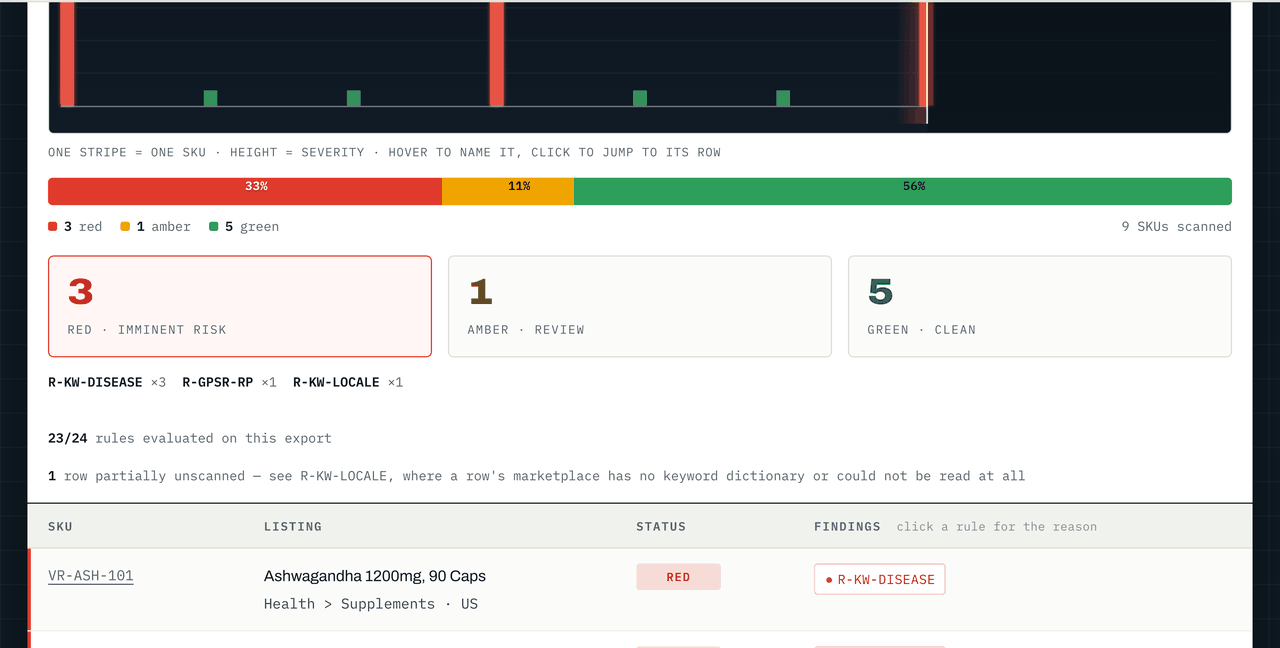
Every stripe in the barcode is a row of your catalog. Nothing is decorative: a tall red stripe is a rule that tripped on that SKU; clean rows sit low and green.
Limitations
- A desk back-test on public case descriptions, not a live-data study. On a real export every red is checked against the seller's own documents, and we report counts per rule, never a rate.
- v1 reads text and attributes only: no product images, no certificate-validity checks, no shared-ASIN ownership resolution.
- Amazon's classifier is opaque. Node-reclassification prediction is probabilistic and shipped as review-assist, never auto-verdict.
- A flat file you export yourself never touches Amazon's services, so nothing in v1 is an agent under the Business Solutions Agreement. Read-only alone would not be the exemption: Section 19 defines an agent as software taking autonomous or semi-autonomous action on your behalf, with no carve-out for tools that only read.
Stop handing you a list once. Keep it current.
What changes
An audit scans your catalog, flags what will trip the bot, and hands back a report with every fix spelled out. You apply the fixes; the file is a snapshot of one day.
Monitoring repeats it, and it is the monthly plan on the pricing page today: each month you download the same report again and it is re-scanned against the rule set as it stands that day, with what changed since the last scan named (fixed, gone with the SKU, new, still open) and every new fix spelled out. No API and no app to revoke: the report is the whole interface. If the marketplace drops a column a rule lists as required, that rule says NOT EVALUATED rather than guess; a dropped column that only sets a rule's scope can move its verdict instead. Same detection engine. Nothing is written to a listing, in any version.
What that costs us
We would rather say this here than be asked. There is no connector today and none is offered here. A flat file you export yourself never touches a marketplace’s services; a connector would, even a read-only one, which makes that step an agent under Section 19 of the Business Solutions Agreement, with every obligation that follows.
Nothing writes anything, in any version. If one is ever built, any such connection would be a separate opt-in with its own authorization, revocable, and it would read; the fix stays yours to apply.
Read your catalog's barcode before the bot scans it.
Five dated duties, four already in force, one direction: stricter.
This isn't a trend piece. Each catalyst below is a live, dated enforcement mechanism that suppresses listings, blocks shipments, or seizes goods.
Every non-food product sold into the EU needs a named Responsible Person per listing. Enforcement is the marketplace's, not the regulation's: eBay states non-compliant listings "may not be visible or purchasable to buyers in the EU and Northern Ireland", restored once the information is provided.
If Amazon cannot confirm that lithium cells over 2.7 Wh in an FBA product sit at 30% state of charge or less, it ships ground-only until further notice. Marketplace policy implementing an air-transport standard, not law.
Certificates must be eFiled for roughly 600 HTS codes on CPSC's own list, April 2026 revision, and it is expressly not exhaustive. Your broker files at customs entry; the failure mode is holds at the border. Foreign-trade-zone goods follow Jan 8, 2027.
Art. 45(4) and 45(6) make marketplaces obtain your per-country EPR registration data and assess it. Member-state penalties are not due until Feb 12, 2027, so the near-term risk is the marketplace gate, not a fine.
Two duties land on one date and the headline hides one. The passport (Art. 77) covers only light means of transport, industrial batteries over 2 kWh and EV batteries, so a power-bank seller reads it and concludes the date is not theirs. But Art. 13(6) puts a QR code on every battery the same day, and Art. 11 requires portable ones to be user-removable.
And these are only the dated ones. Amazon's title rules, Prop 65, California SB 1215, state EPR and CARB VOC limits arrive on no calendar day at all. Each widens the gap between what platforms validate and what the law requires.
Marketplaces validate structure. The law is contextual.
Every managed marketplace runs a version of the same five-stage pipeline. A listing can pass stages 1–3 schema-perfect and still violate GPSR, CPSC certificate rules, textile labeling or hazmat law. Those checks fall to capacity-bound reviewers, or to enforcement bots after publication. That is when suppression and liability hit.
Schema validation
Required fields, formats, image specs. Instant and rule-based.
checks structureAutomated gating
Brand and category authorization, keyword screens, price sanity.
checks structureData quality
Variant grouping, duplicates, taxonomy mapping.
checks structureHuman review
Regulated categories only. Queues run weeks; capacity is fixed.
bottleneckEnforcement bots
Policy bots, test buys, recalls ingestion, suppression.
after publicationStructure vs law
Validation engines pass listings that violate GPSR, CPSC, and labeling rules. Sellers clear submission, then get suppressed.
Opacity
Suppressions ship with no rule ID, no reason, no fix. Every Pronoia flag names all three.
Rule churn
Requirements land as new attributes in the marketplaces' own release notes and on dated policy pages. Three 2026 waves: cGMP, lithium Jan 2026, 75-char titles Jul 2026. We diff the notes, so you read the diff.
Review capacity
Human queues run weeks and don't scale with catalog growth.
Channel re-work
Obligations follow the product; every platform encodes them differently. One normalized ruleset, thin adapters per platform.
Observability
Sellers can't see where a submission sits or why it's stuck. An audit is portable observability for your own catalog.
Recovery
Blocked listings sit until a human notices. Entering the pipeline wrong costs weeks, not minutes.
Regulatory velocity
GPSR, INFORM, CPSC eFiling, state layers, the Feb 2027 battery QR code and removability duties. Obligations compound faster than platform tooling.
The market prices this pain today. Reactively.
€199/yr covers one product; €1,190/yr up to 5,000 items, €2,990/yr above. One regulation (GPSR), for EU market access. No monitoring, no other rules.
Published per-case pricing: $1,500 flat, $2,300 for IP or related-account matters, $1,495 for a 72-hour reinstatement, $1,500 per single ASIN appeal. Seller Candy's Unlimited plan starts at $797/mo. Every one of those clocks starts after the suppression.
Riverbend's Guardian starts here, custom-quoted above it. Reactive by design: they respond to flags Amazon has already raised.
And the pressure is systemic, not just Amazon
Up 13%, a record, on the Commission's own count; cosmetics and toys are over half of it. Marketplace listing removals inside that: 498 in 2025, 244 in 2024.
Whaleco (Temu), Sept 8, 2025, for missing seller disclosures. Past 200 sales and $5,000 in a year, your marketplace must verify your bank and tax details or suspend you.
The Jul 29, 2024 Decision and Order holds Amazon a CPSA distributor for FBA products. Under challenge; no final ruling as of Aug 2026.
The eSurveillance crawler inspected over 1.6 million URLs in every EU official language in 2025. Marketplaces it notifies must react within three working days.
By the end of 2025, under the GPSR Art. 22(1) registration duty. National authorities notified 5,794 follow-up actions, up 35% year on year. The compliance surface is not one storefront.
0.88 across the EU, by Amazon's own accounting, Jul-Dec 2025: roughly one in eight automated enforcement actions is a false positive. Being correct before the bot looks beats being right afterwards.
Every number on this page, with its source
Sources for every figure we cite. Where a number is derived rather than published, we say so and name the method. Where a claim could not be sourced, we removed it rather than soften it.
- Amazon EU DSA transparency report, Jul-Dec 2025 — 113.1M own-initiative enforcement measures against 45,652 notices received; 17,032 complaints, 67.3% upheld, median 5 days; moderation precision 0.88 EU-wide, 0.54 Belgium. Published Feb 27, 2026. Precision is Amazon's own, self-assessed, and scoped to the automated subset.
- Amazon EU DSA risk assessment, 2025 — “more than ten thousand safety and compliance keyword-based algorithms”, and “When we identify and remove a non-compliant or unsafe product offer, we inform the Seller of the violation.”
- EU Safety Gate 2025 report (DG JUST) — eSurveillance inspected 1.6M+ URLs, 20,800+ contained dangerous products; 1,200+ marketplaces registered; 5,794 follow-up actions, up 35%. Published Mar 9, 2026.
- European Commission, Safety Gate 2025 — “alerts through its rapid warning system rising 13% to 4,671, the highest level on record”, and “Cosmetics and toys accounted for over half of the reported cases”. Published Mar 9, 2026. Our own count of the 2025-dated weekly reports gives 4,704 notifications published, or 4,636 carrying a 2025 case number; the Commission's 4,671 sits between the two, which is the gap between counting by submission year and by publication week. We cite their figure, not ours.
- EU Safety Gate weekly reports (API) — 498 marketplace listing removals in 2025, 244 in 2024, of which 62 authority-ordered and 440 voluntary. As a share of all notifications that is 10.6% in 2025 (498 of 4,704) against 6.0% in 2024 (244 of 4,066). Not a published Commission figure: we derive it from all 103 weekly reports published in those two years by counting notifications whose measures carry the category “Removal of this product listing by the online marketplace”, taking ordered versus voluntary from the header of that same measure block (“to whom the measure(s) were ordered” versus “taking notified measure(s)”). Four 2025 notifications carry both routes and are counted in each, so 62 and 440 sum past 498. Reading “ordered” from anywhere in the field instead of the matching block would give 84, which is why we do not. We publish no part-year 2026 figure, because an open year revises after publication: re-running this on Aug 19, 2026 returned 417 removals for weeks 1 to 30 where the same window read 419 on Aug 5, while both closed years reproduced exactly.
- GPSR, Regulation (EU) 2023/988 — Applies Dec 13, 2024. Art. 22(1) marketplace registration, Art. 22(4) two working days on an order, Art. 22(11) suspension of traders who frequently offer non-compliant products.
- PPWR, Regulation (EU) 2025/40 — Applies Aug 12, 2026. Art. 45(4) and 45(6) marketplace duties. Art. 68 gives Member States until Feb 12, 2027 to set penalties, so no new PPWR fine attaches on the date.
- CPSC guidance and HTS list, electronic certificates — “approximately 600 Harmonized Tariff Schedule (HTS) codes ... it does not encompass all HTS codes where an electronic certificate may be required.” April 2026 revision.
- CPSC Decision and Order, In the Matter of Amazon.com — July 29, 2024. “Amazon does not dispute that its customers purchased over 400,000 hazardous items.” Under challenge in Amazon.com, Inc. v. CPSC (D. Md., filed Mar 14, 2025); no final ruling reported as of Aug 2026.
- DOJ, Temu INFORM Consumers Act settlement — $2M civil penalty, stipulated order entered Sept 8, 2025, for missing seller disclosures and reporting mechanisms.
- Amazon Seller Forums, compliance document review time — “it can take up to 15 business days (weekends are not counted in this review process)”, stated by an Amazon community manager. A ceiling, not an average.
- eBay GPSR seller guidance — Non-compliant listings “may not be visible or purchasable to buyers in the EU and Northern Ireland”, restored when the information is provided.
- Appeal and retainer pricing — $1,500 flat, $2,300 IP or related-account (AMZ Sellers Attorney, page last reviewed Jul 12, 2026). Also $1,495 for a 72-hour account reinstatement, $1,500 per single ASIN appeal, Seller Candy from $797/mo, Riverbend Guardian from $17/day.
- EU Responsible Person pricing — EUR 1,190/yr to 5,000 items, EUR 2,990/yr above it. Entry pricing from EUR 199/yr covers a single product.
Our desk back-test is a study on publicly documented cases, not a live-data study. We no longer publish a score from it: the cases were never individually cited and the forum source can no longer be queried to reproduce them, so the figure was unfalsifiable rather than wrong. What we publish instead is the corpora each rule is measured against, in Fig. 13. We publish no conversion or ranking uplift figure, because no methodology-backed study links attribute completeness to either on any marketplace.
Your numbers, their published prices.
Not a projection. Enter suppressions you have actually had; we multiply by prices the appeal firms print themselves.
Every price above is linked in Every number on this page, with its source. SafeToList, the closest competitor, publishes $1,950 one-time for up to 1,000 SKUs, $4,950 one-time for up to 10,000, and $1,500 per month to keep monitoring. Theirs is a human review with a findings call and ours is a deterministic rule pass you run yourself, so they are not the same product priced differently. Read Aug 10, 2026.
Everyone touches compliance data. Each layer stops somewhere; here is where.
From vendors' own public releases and docs: the existing stack transports, moderates and verifies, and the suites that do check field completeness connect to the account and write to it. Pronoia reads an export with no credentials and never writes.
| Layer | What it does | What it doesn't |
|---|---|---|
| Platform dashboards (Amazon's Regulatory Compliance section and peers) | Show what that marketplace's own enforcement has already raised, with due dates and an at-risk filter | Flag anything before that marketplace opens a case, or read the catalog you sell everywhere else |
| Marketplace SaaS (catalog + trust & safety modules) | Data mapping and quality; AI moderation of illegal content | GPSR / CPSC attribute completeness |
| Feed and listing-sync tools | Transport and transform listing data across channels | Risk-score what they transport |
| Seller identity verification | INFORM / KYB identity checks on the seller | Read the listings at all |
| Illicit-product screening | Detects illicit, recalled, counterfeit products | Regulatory attribute gaps |
| RP services + appeal agencies | One regulation covered; recovery after suppression | Monthly monitoring before a case opens |
| Pronoia | Reads your export against the rules before the platform acts | Listing writes. Read-only by design |
Every keyword term is priced against real corpora before it ships.
A term is measured on both sides: what it catches, and what it costs on lawful copy. One that scores a gain on one side and a cost on the other is refused, however good the catch rate looks alone.
| Corpus | Size | Side it measures | Source |
|---|---|---|---|
| Dietary-supplement label names | 160,365 | False positives on lawful copy | NIH DSLD |
| Recall titles and product names | 21,452 | False positives on real product names | CPSC SaferProducts |
| Adjudicated claim strings | 9,477 | True positives, quoted by the regulator | FDA warning letters (833) |
| OTC drug labels | 6,000 | Warning text vs claim text, two-sided | openFDA, a 12% sample |
Every corpus here is a convenience population, not a sample of the listings we score, so a measurement can convict a term and cannot acquit one: a zero may be the corpus rather than the rule. The OTC set is 6,000 of the 49,825 labels openFDA reports for that query. We also run a desk back-test against publicly documented cases; it is a desk study on public case descriptions, not a live-data study, and we no longer publish a score from it, because the cases are not individually cited and the forum source can no longer be queried to reproduce them.
Same scan, your real catalog.
Pick a problem you have had. Watch the engine find it.
Not a recording and not sample output. These are the production v1 rules executing in your browser on synthetic catalogs modeled on documented suppression cases. Most are Amazon-flavored, one is a Walmart item spec and one is a Google Shopping feed, each read through the same rules via that platform’s own column names. Or paste your own rows: everything runs locally, nothing is uploaded.
Four checks to run on any tool before you hand it a catalog.
Run them on us first. Every verdict below is something you can confirm in your own browser in under a minute, which is the only kind of claim worth printing next to a barcode that means something.
localStorage, no sessionStorage, no analytics, no page-view counter, so no consent banner and no sub-processor. Check it: Application tab, Storage. It is empty.
connect-src 'none', so the page cannot open a network connection at all, to us or to anyone: a future version that tried to send your catalog somewhere would be stopped before the request left your machine, whatever its code said. Check it: read the content-security-policy response header.
Same scan, your real catalog.
Free for our first sellers, one audit each. Then $99 to $499 a month.
- Full rule set v1 scan of your Category Listings Report
- Every flag with its rule, reason and fix; rules the file cannot support listed as NOT EVALUATED
- Top-5 fix-this-week queue with remediation copy
- Delivered same day, no account access
Booking is optional either way. Free for our first sellers, one audit each, with no obligation after it. Before we run your file we reply to say whether a free place is open; if none is, the audit is month one of monitoring at the tier for your SKU count, and nothing runs until you have the price and terms in writing and have said yes. Payment is not open yet.
- Each month you download the same report; we send back what changed
- Rule updates as enforcement changes (GPSR, CPSC, DPP)
- Amazon US today; Walmart, eBay and Google files read for what each export carries
- Agency pricing per catalog on request
A 30-minute call, then month one at the tier for your SKU count, on terms we send you in writing before anything is paid. Payment is not open yet. Month two only on your written yes.
- A dated pre-fix scan naming the rule that fired, and a post-fix rescan diff
- Matches Amazon’s appeal structure: root cause, corrective action, preventive measures
- Both source files fingerprinted with SHA-256 digests, printed in the exhibit
- A finding that vanished with its SKU is counted as dropped, never as fixed
This documents evidence, not outcomes: nobody can promise what Amazon accepts, and we don’t.
A single ASIN appeal is published at $1,500, and Amazon's own compliance-document review runs up to 15 business days with your listing down. Monitoring exists so you never enter that queue.
Asked before you had to.
Do you get access to my seller accounts?
My marketplace already has a compliance dashboard. Why this?
is_compliant column, which is genuinely better than a dashboard — for Kaufland. Your catalog is not per-marketplace. Pronoia reads one export against every rule at once, before any of them has opened a case, and gives you the wording to fix it.Why doesn't the marketplace catch this when I submit the listing?
My feed tool already manages listing data. Doesn't it cover this?
Which file do I send for the audit?
Do you auto-fix my listings?
Will the scan produce false alarms?
I run an agency. Can I white-label this?
Do you only cover Amazon?
Is the demo on this site real?
What we do with your data.
What this site collects, what happens to an export you send us, and who processes it.
Last updated 10 August 2026
The demo never sends your catalog anywhere. This site sets no cookies and loads nothing from a third-party server.
The live demo runs on your device
The rule engine on the Live demo tab is JavaScript in the page you already downloaded. When you paste a CSV, the parse, the rule evaluation and the report render all happen in your browser's memory. There is no upload step. Close the tab and the data is gone.
The site is served with a Content Security Policy whose connect-src 'none' and form-action 'none' directives forbid the page from opening a network connection or submitting a form at all. Your browser enforces that, not us.
What this site collects
Nothing. No analytics, no cookie, no identifier, nothing written to your device. Typefaces are served from our own domain rather than Google Fonts, so loading this page does not disclose your IP address to a third party. Our host sees the ordinary web-server request for the page itself, which is how the internet delivers a file.
What happens when you email us a listings export
You send it, so this part is your choice and not a background process. Here is the whole lifecycle:
| Question | Answer |
|---|---|
| What we use it for | Running the rule set and writing your audit. That only. |
| Where it goes | Our mailbox, and the machine the audit is run on. It is not uploaded to any analytics, CRM or AI service. |
| How long we keep it | The raw export is deleted within 30 days of delivering your audit. Ask sooner and we delete it sooner. |
| What we keep after that | Counts. How many rows, how many flags, which rule IDs fired. No titles, no SKUs, no identifiers, nothing that reconstructs your catalog. |
| Model training | Never. Your catalog is not used to train or fine-tune any model, ours or anyone else's. This is also a contractual obligation we are under, not only a preference. |
| Sharing and sale | Never sold, never brokered, never shared with another seller, agency or marketplace. |
| Account access | None is requested and none would be accepted. We do not want your credentials. |
A listings export is commercial data about products rather than about people, but it can carry a named responsible person or a manufacturer contact, which is personal data. We treat the whole file as if it does.
Our processors are a website host, a mail router and mailbox provider, and a scheduling tool used only if you book a call. Named on request: audit@trypronoia.com.
Legal basis, transfers and your rights
For visitors in the UK, EU and EEA: the only processing we do is performing a service you asked for, when you email us an export for an audit. No consent banner appears because nothing here requires consent.
Pronoia is operated from the United States by its founders, so an export you email us is processed there. A registered company name and postal address will be published here at incorporation.
You can ask us what we hold about you, ask for a copy, ask us to correct it, ask us to delete it, or object to the processing. One email does it and we will answer within 30 days. If you are in the EU or UK you can also complain to your national data protection authority.
Security
The site is static, serves over HTTPS only, and carries HSTS and a Content Security Policy. It has no login, no database and no user accounts. Exports you email us live on encrypted disks and are deleted on the schedule above.
Children
This is a business tool. It is not directed at anyone under 18 and we do not knowingly collect data from them.
California
We do not sell personal information and we do not share it for cross-context behavioural advertising. There is no opt-out link here because there is nothing to opt out of.
Contact
Data protection questions and requests: audit@trypronoia.com.
If this notice changes materially, the date above changes.